
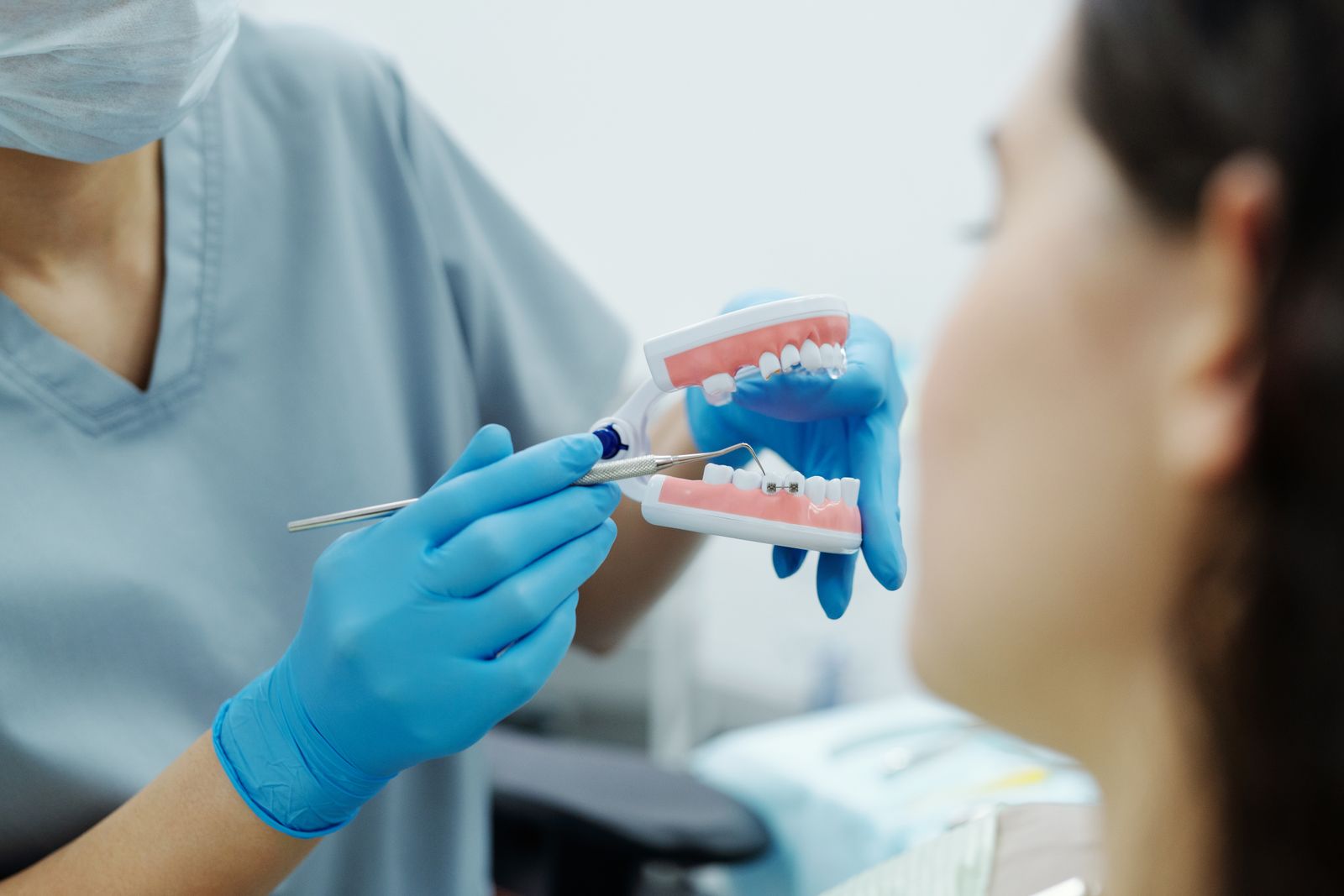
If you are missing a front tooth but do not want healthy neighbouring teeth to be reduced for crowns, a Maryland bridge may be an option. Also called a resin-bonded or adhesive bridge, it replaces the missing tooth with an artificial tooth that is bonded to the inner surfaces of the teeth next to it. Here we answer the questions we hear most often at our Korupark and Ataevler branches in Bursa.
What is a Maryland bridge?
A Maryland bridge is a fixed prosthesis used to replace a single missing tooth. The artificial tooth has thin “wings” on one or both sides. These wings are bonded to the tongue-facing surfaces of the neighbouring teeth, so from the front only the artificial tooth is visible.
Single-wing designs and all-ceramic materials are now widely used.
How is it different from a conventional bridge?
In a conventional fixed bridge, the teeth on either side of the gap are reduced all round and crowned. With a Maryland bridge the front surfaces of the neighbouring teeth are left untouched, and any preparation usually stays within the enamel on the inner surface.
- Tooth structure is preserved: little or no tooth tissue is removed.
- Fewer visits: the process is usually shorter.
- Keeps options open: because the teeth are largely preserved, moving to an implant later is easier.
- Limitation: it may not suit areas with heavy chewing forces or certain bites.
Who is it suitable for?
- People missing a single front tooth
- Young people born without a lateral incisor
- Teenagers and young adults who cannot have an implant yet because the jaw is still growing
- People whose neighbouring teeth are healthy with few or no fillings
- Patients who want to close a gap with a fixed tooth after orthodontic treatment
Who may it not suit?
- People who clench or grind their teeth at night
- People with a deep bite, where the upper teeth overlap the lower teeth a lot
- People whose neighbouring teeth are very short, thin or heavily filled
- People with mobile neighbouring teeth or advanced gum disease
- People missing several teeth in a row
In these cases options such as an implant or a conventional bridge can be considered.
How is it made?
- Examination and X-rays: the health of the neighbouring teeth, the gums and the bite are assessed.
- Preparation: if needed, a small seat is prepared on the inner surface of the neighbouring teeth, usually without anaesthetic.
- Impression: a conventional impression or a digital scan is taken.
- Laboratory: the bridge is made to match your tooth shade.
- Try-in and bonding: fit, colour and bite are checked before the bridge is bonded.
Which materials are used?
Metal-framed porcelain bridges used to be common. Today all-ceramic materials such as zirconia or glass ceramic are often preferred for appearance. The right material depends on tooth colour, thickness and bite forces.
Care and everyday use
- Clean under and around the bridge with a floss threader or interdental brush.
- Avoid biting very hard foods with the bridge and do not bite nails or pens.
- If you grind your teeth at night, tell your dentist; a night guard may be advised.
- Regular check-ups include the bonded areas and the gums.
If the bridge comes off, do not throw it away. Keep it in a clean container and bring it to the clinic; this improves the chance of re-bonding.
Frequently asked questions
Do the neighbouring teeth need to be cut for a Maryland bridge?
Not in the way they are for a conventional bridge. In most cases only a very small preparation, limited to the enamel on the inner surface, is needed; sometimes none at all.
Can a Maryland bridge come off?
The most common problem is the bridge coming unstuck. If the tooth and bridge are intact, it can often be cleaned and bonded again. Keep the bridge and contact the clinic promptly.
Can a Maryland bridge be used for back teeth?
Back teeth carry heavier chewing forces, so it is usually not the first choice there. Suitability depends on your bite and the condition of the neighbouring teeth.
Maryland bridge or implant?
If bone and gums are suitable and growth is complete, an implant is also a strong option for a single missing tooth. A Maryland bridge is often considered for young people who are still growing, or for front teeth where the neighbouring teeth should not be prepared. The decision is made after an examination and X-rays.
How many visits does a Maryland bridge take?
Usually a few: examination and impression, try-in and bonding. The number depends on the material and the laboratory process.
Maryland bridge examination in Bursa
Whether a Maryland bridge suits your missing front tooth is decided after an examination, X-rays and a bite check. You can book an appointment at either of our branches in Bursa:
Korupark Branch (Osmangazi): +90 224 243 00 44 · WhatsApp +90 532 497 11 17
Ataevler Branch (Nilüfer): +90 224 503 66 00 · WhatsApp +90 552 503 66 00
Korudiş Dental Team
This article is for general information; the right treatment for you can only be decided by your dentist after an examination.
You can find the profile of our dentist with an interest in prosthetics and digital planning on the Dt. İlhan Şirin page.