
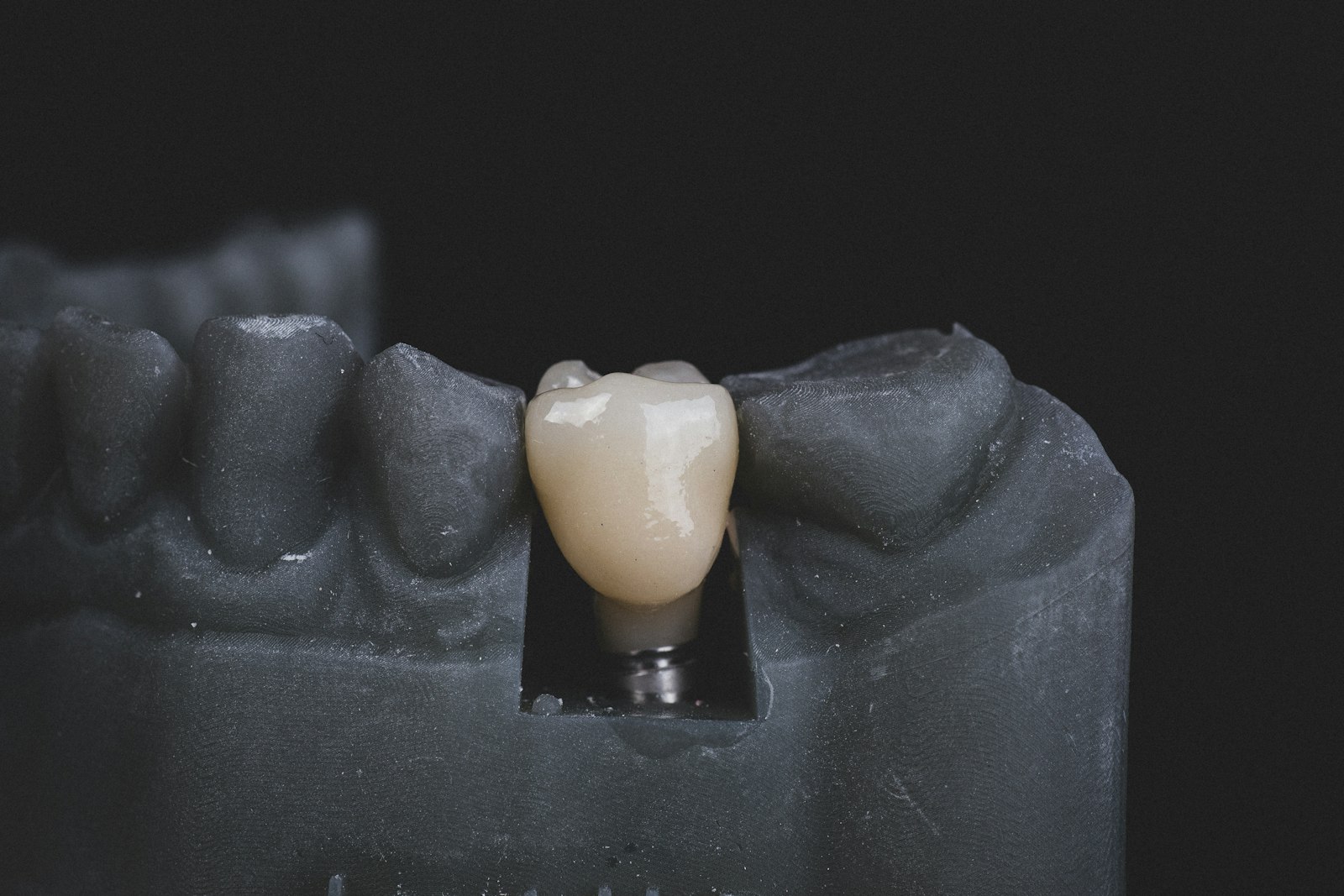
Implant treatment has two parts: the implant placed in the jawbone and the tooth made on top of it that you see in the mouth. This second part is called an implant-supported prosthesis. It can be a single tooth or a prosthesis that covers the whole jaw. In this article we answer the question we are asked most often at our Korupark and Ataevler branches in Bursa: “Which prosthesis is right for me?”
What is an implant-supported prosthesis?
An implant is a small screw that takes the place of a tooth root. Once the implant has fused with the bone, a connecting part (abutment) is attached to it, and the actual tooth is cemented or screwed onto this part. The tooth you see and chew with is this upper structure.
The time needed for the implant to fuse with the bone varies by person and jaw. During this period a temporary tooth can be made, especially for front teeth.
Types of implant-supported prosthesis
Single tooth: implant crown
For a single missing tooth, one implant and one crown on top are made. The neighbouring teeth are not touched.
Several teeth: implant bridge
If several teeth in a row are missing, a separate implant may not be needed for each tooth. A bridge can be made on two or more implants.
Full arch, fixed: hybrid prosthesis
In a jaw with no teeth left, this is a one-piece prosthesis usually screwed onto at least four implants. The patient does not remove it; the dentist can take it off for maintenance and check-ups. In people with bone loss, the missing gum is also restored with the pink part of the prosthesis.
Full arch, removable: snap-on denture (overdenture)
This is a complete denture held onto implants with attachments or a bar. In the lower jaw it can usually be made with two implants. The denture is taken out for cleaning, but because it sits on the implants while in the mouth, movement is noticeably reduced. It is a common option for people whose lower complete denture moves.
Screw-retained or cemented?
Implant-supported fixed prostheses are either screwed or cemented onto the implant. The advantage of a screw-retained prosthesis is that the dentist can easily remove it for cleaning and repair when needed. A cemented prosthesis can have an aesthetic advantage in some cases. The choice depends on the position of the implants and the type of prosthesis.
Which materials are used?
Single teeth and bridges are mostly made of zirconia or porcelain fused to metal. In hybrid prostheses, acrylic or zirconia teeth can be placed on a metal or titanium framework. The material is chosen based on chewing forces, aesthetic expectations and ease of maintenance.
Which one is right for me?
The decision mostly depends on:
- How many teeth are missing and the condition of the remaining teeth.
- The amount and quality of bone (assessed with X-rays and, if needed, 3D tomography).
- Whether you want a fixed or a removable prosthesis.
- How easily you can clean your mouth.
- Your general health and smoking.
How is an implant-supported prosthesis made?
- The implant is allowed to fuse with the bone and is checked.
- The position of the implants is recorded with an impression or an intraoral scanner.
- If needed, the tooth arrangement and bite are tried in.
- The prosthesis is fitted and the bite is adjusted.
- At check-ups, the screws, gums and cleaning are checked.
Caring for an implant-supported prosthesis
An implant does not decay, but the gum and bone around it can become inflamed. This is called peri-implantitis and can progress to implant loss. The way to prevent it is regular cleaning:
- Brush twice a day, paying attention to where the implant meets the gum.
- Use an interdental brush; a water flosser makes cleaning easier for hybrid prostheses.
- Take out a snap-on denture every day and brush it, cleaning the attachment inserts too.
- Come for a check-up at least once a year, or at the intervals your dentist recommends for hybrid prostheses.
What affects the cost of an implant-supported prosthesis?
The cost depends on the number of implants, the type of prosthesis (single tooth, bridge, hybrid or snap-on), the material used and whether additional procedures such as bone support are needed. We share the plan that suits you and its cost clearly after the examination and X-ray assessment.
Frequently asked questions
How many implants are needed for a full arch?
A fixed hybrid prosthesis usually needs at least four implants. A snap-on denture can be made with two implants in the lower jaw. The exact number depends on your bone structure.
Hybrid or snap-on denture?
A hybrid prosthesis stays fixed in the mouth, while a snap-on denture is taken out for cleaning. Because it can be made with fewer implants, a snap-on denture may be a more suitable starting point for some people.
Can my existing complete denture be converted to sit on implants?
If the denture is in good condition and the implants can be placed in the right positions, attachments can sometimes be added to your existing denture. This is assessed at the examination.
How long does an implant-supported prosthesis last?
With regular cleaning and check-ups it can be used for many years. Parts such as attachment inserts and acrylic teeth wear over time and may need to be renewed.
Can an implant tooth come loose?
Rarely, a screw may loosen or the cement may fail. If you feel the tooth moving, see your dentist without delay; early intervention is easier.
Implant-supported prosthesis examination in Bursa
Which implant-supported prosthesis suits you is decided with an examination and X-rays. You can book an appointment at our two branches in Bursa:
Korupark Branch (Osmangazi): +90 224 243 00 44 · WhatsApp +90 532 497 11 17
Ataevler Branch (Nilüfer): +90 224 503 66 00 · WhatsApp +90 552 503 66 00
Korudiş Dental Team
This article is for general information; the right treatment for you can only be decided by your dentist after an examination.