
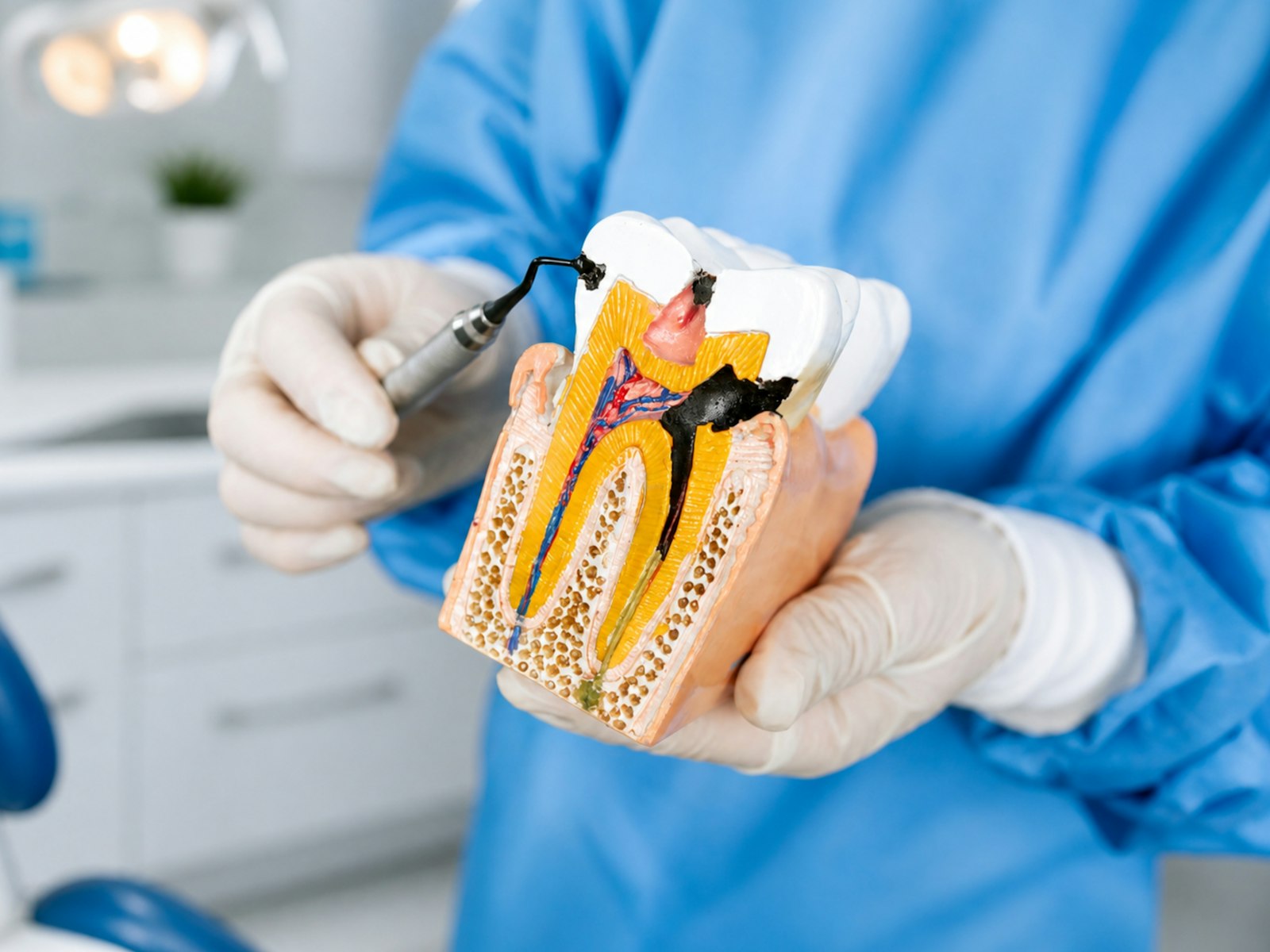
Some cavities or fractures on the side of a tooth extend below the gum. This makes repairing the tooth harder, and our patients ask, “Will this tooth have to be extracted?” Deep margin elevation (DME) is a preparatory step used to make repair possible or safer in such teeth. We have explained this frequently asked topic in plain language from our Korupark and Ataevler branches in Bursa.
What is deep margin elevation?
The “margin” is the edge where the restoration meets the tooth. When decay extends below the gum, this edge also ends up below the gum line. In deep margin elevation, a thin layer of composite (tooth-coloured filling) is placed in the deepest part of the margin. This moves the margin up to the gum line or above it.
In the literature it is also called “cervical margin relocation”. DME is not a treatment on its own; it is a preparation for the restoration that follows (an onlay, overlay or crown).
Why is it needed?
Working with a margin below the gum is difficult for several reasons:
- Gum fluid and blood can interfere with bonding.
- The margin may not be clearly visible in an impression or digital scan.
- The margin becomes harder to clean, which can increase the risk of new decay and gum inflammation over time.
When the margin is moved up, these problems are reduced and the main restoration can be done in a more controlled way.
How is it done?
- X-ray and examination: How deep the decay goes and how close it is to the bone are assessed.
- Isolation: The tooth is separated from saliva and blood with a thin sheet called a rubber dam. This is the most critical step of DME.
- Cleaning: The decay and any old filling are completely removed.
- Raising the margin: A thin band (matrix) is placed around the tooth, the deepest part of the margin is filled with composite and hardened with a light.
- Restoration: An impression is taken in the same or a later session, and an onlay, overlay or crown is made.
Who is it suitable for?
It is considered for back teeth with decay or a fracture on the side that extends below the gum, where good isolation can be achieved with a rubber dam. It is often used for teeth planned to receive an onlay, overlay or ceramic crown.
If the margin is very close to the bone or isolation cannot be achieved, DME may not be suitable. In that case other options are considered.
What are the alternatives to DME?
- Crown lengthening: Exposing more of the tooth by reshaping the gum and, if needed, the bone with a minor surgical procedure.
- Orthodontic extrusion: Slowly pulling the tooth up with orthodontics.
- Extraction and replacement with an implant or bridge: When the tooth cannot be saved in the long term. We compare these options in our implant or bridge article.
In some cases DME can reduce the need for surgery. Which path to take is decided by assessing the condition of the tooth together with your preferences.
How reliable is it?
DME is part of approaches that aim to preserve tooth structure and shows promising results in clinical studies. However, its long-term results and effect on gum health are still being researched. Success depends mostly on good isolation, correct case selection and keeping the margin clean afterwards.
What to pay attention to afterwards
- Clean this area every day with dental floss or an interdental brush.
- Tell your dentist if you notice bleeding, swelling or sensitivity in the gum.
- Come for a check-up at least once a year; the margin can be monitored with X-rays.
What affects the cost of deep margin elevation?
DME is usually planned together with the main restoration. The cost depends on how many teeth are treated and which restoration, such as an onlay, overlay or crown, follows. We share the plan that suits you and its cost clearly after the examination.
Frequently asked questions
Is deep margin elevation a filling?
A tooth-coloured filling material is used, but its purpose is not to repair the tooth on its own; it moves the margin up for the restoration that follows.
Does decay below the gum always mean extraction?
No. With DME, crown lengthening or orthodontic extrusion, some of these teeth can be saved. The decision is made with X-rays and an examination.
Does DME hurt?
It is done under local anaesthesia when needed. During the procedure most people only feel the pressure of the rubber dam and the matrix.
What is the difference between DME and crown lengthening?
In DME the margin is moved up with a filling and the gum is not operated on. In crown lengthening, the gum and, if needed, the bone are reshaped surgically.
Does every dentist do DME?
DME requires experience with rubber dam isolation and adhesive (bonding) techniques. Whether it is suitable for you is assessed at the examination.
Deep margin elevation examination in Bursa
Which path suits a cavity or fracture that extends below the gum is decided with an examination and X-rays. You can book an appointment at our two branches in Bursa:
Korupark Branch (Osmangazi): +90 224 243 00 44 · WhatsApp +90 532 497 11 17
Ataevler Branch (Nilüfer): +90 224 503 66 00 · WhatsApp +90 552 503 66 00
Korudiş Dental Team
This article is for general information; the right treatment for you can only be decided by your dentist after an examination.